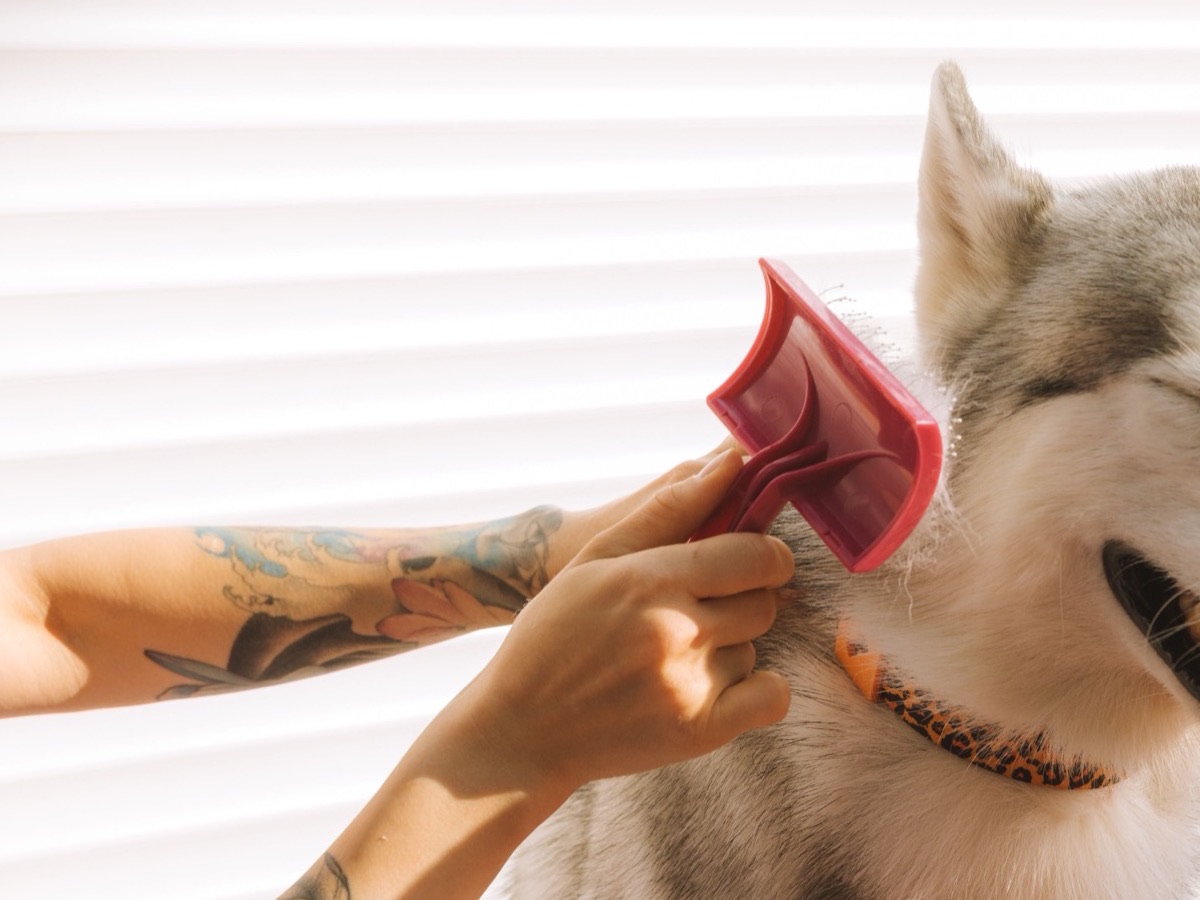
A dog does not have to enjoy being brushed. It helps enormously if they are not ambushed by it, and if the first sessions take less time than a kettle boil.
The first time I brushed Nell, she lay down and showed me her teeth. Not a snap, just a display: a small, bearded terrier saying that this was not part of the deal. She was two, newly adopted, and had never been taught that a brush was harmless. Ten years on, she leans into it. The change took about a month of very short sessions and a great many pieces of chicken.
Start with the easy places
Most dogs tolerate their shoulder or the side of their neck before they tolerate their feet or their tail. Begin where the dog is already comfortable being touched. Brush three strokes, praise, stop. That is the whole first session. The second can be four strokes.
Do this at a time when the dog is already calm, not when they are expecting a walk. The floor by the radiator after dinner is better than the doormat at ten in the morning.
Short sessions, good treats
A grooming session should end before the dog wants it to. Two minutes is plenty at the start. Keep a small bowl of something excellent within reach and deliver a piece after each stroke, not after each full brush-out. The treat marks the moment the brush touches, which is the part that needs the work.
If the dog leaves, let them. Do not hold them in place for a full groom and call it training. A dog who can walk away learns that staying is a choice, and choices are easier to repeat.
Nails and ears
Nails are the most common flashpoint. Handle each paw for a few seconds, without clipping, for a week. Then clip one nail and stop. If your dog has dark nails, take off the smallest sliver you can and check the cut surface; a vet or groomer can show you where the quick sits.
Ears need less than people think. A look inside once a week, and a wipe round the outer flap with a dry pad if it is grubby. Do not dig into the ear canal with a cotton bud. If the ear smells strongly or the dog shakes their head repeatedly, that is a vet question rather than a grooming one.
Washing, only when needed
Most dogs do not need a bath often. Nell gets one when she has rolled in something with a smell, which is roughly twice a year. Bathing strips the coat of its natural oils, and a dog who is bathed every fortnight will often look duller for it.
When you do wash, use a dog shampoo, dilute it, and rinse properly. A non-slip mat in the bath helps. So does a smear of peanut butter on the tiles at nose height, if your dog is food-motivated and not allergic to it. Dry the dog thoroughly afterwards, and keep them warm for an hour.
Know when to stop
Some coats need professional help: hand-stripping, matted feathers, a doodle cross with a coat like steel wool. There is no shame in a groomer. Find one who will let you stay for the first appointment, and who talks to the dog rather than over them.
If your dog has a skin condition, a recent injury, or is elderly and stiff, ask the vet what is reasonable before starting. Grooming an old dog on a hard floor for twenty minutes is a different job from grooming a young one.
Home grooming is not about a show coat. It is about a dog who can be handled without fear: by you, by a vet, by a groomer, by a stranger at the door. Every calm two minutes with a brush is a deposit in that account.
Nell still shows her teeth occasionally, usually when I get to the tail. Then she sighs, lies flat, and lets me finish. That, more than a perfect coat, is what I was after.